The Economic Impact of Modular Construction on Urban Housing
The Economic Impact of Modular Construction on Urban Housing
The Shift Toward Industrialized Construction
Urban housing crises around the world are forcing developers to look for faster, more cost-effective ways to build. Modular construction, where sections of a building are manufactured in a factory and assembled on-site, has emerged as a frontrunner. This industrialized approach to building offers a radical departure from traditional methods. By moving the majority of the work into a controlled environment, developers can achieve a level of precision and speed that was previously impossible. The economic implications of this shift are profound, affecting everything from labor costs to financing structures. As cities become more crowded, the ability to deliver high-quality housing quickly becomes a critical economic driver for urban centers.
Time-to-Market and Revenue Generation
One of the most significant economic advantages of modular construction is the dramatic reduction in project timelines. In a traditional build, site preparation and building construction happen sequentially. In modular projects, these processes occur simultaneously. While workers are digging foundations and installing utilities on-site, the building modules are being fabricated in a factory. This can shorten the total construction time by up to 50%. For developers, this means the building can be occupied months or even years sooner. Earlier occupancy leads to faster revenue generation through rents or sales, significantly improving the project's internal rate of return (IRR). This speed also reduces the duration of construction loans, saving millions in interest payments.
Labor Efficiency and Cost Predictability
Traditional construction sites are notoriously unpredictable environments. Weather delays, labor shortages, and logistical bottlenecks frequently lead to cost overruns. Modular construction mitigates these risks by moving production indoors. Factory settings allow for optimized labor workflows and the use of automated machinery. Workers operate in a safer, more ergonomic environment, which increases productivity and reduces insurance costs. Furthermore, material waste is significantly lower in a factory, as off-cuts can be repurposed for other modules. This efficiency leads to high cost predictability, a factor that is highly valued by investors and lenders. The DisciplineBridge Review Manual points out that this predictability is essential for large-scale urban developments where budgets are often razor-thin.
Scaling and Replicability in Urban Environments
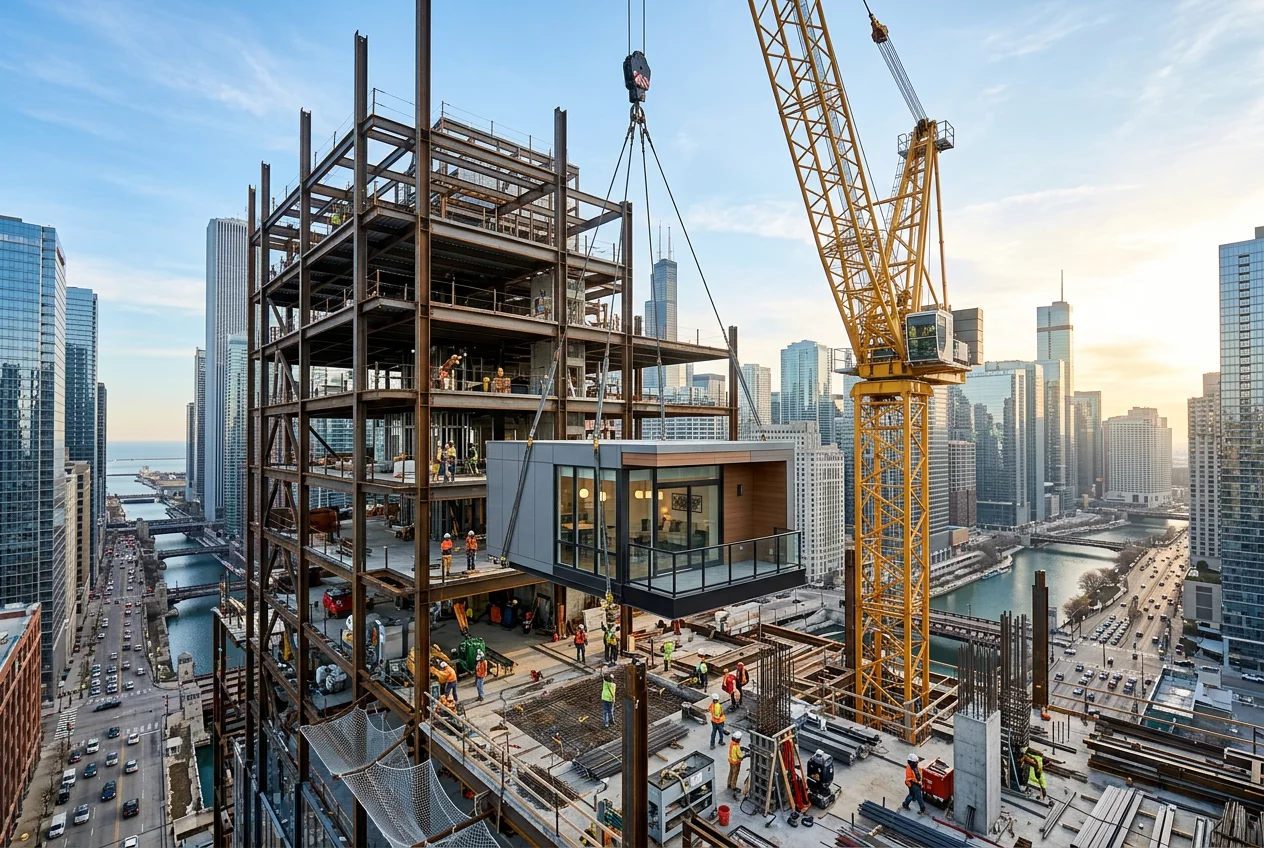
The modular approach is particularly suited for high-density urban housing. Small, awkward city lots often make traditional construction logistics a nightmare. Delivering pre-finished modules and hoisting them into place with a crane minimizes the disruption to the surrounding neighborhood. Once a modular design is perfected, it can be replicated across multiple sites with minimal changes. This scalability allows developers to achieve economies of scale, purchasing materials in bulk and refining their production processes with each project. Over time, this leads to a decrease in the per-unit cost of housing, making it more affordable for the end-user. The ability to mass-produce high-quality, sustainable homes is key to solving the housing shortages in major metropolitan areas.
Sustainability as an Economic Asset
Beyond speed and cost, the sustainability of modular construction provides a long-term economic benefit. Buildings produced in factories typically have tighter building envelopes and better insulation than those built on-site, leading to lower energy costs for residents. The reduction in material waste and the ability to recycle modules at the end of their life cycle align with the growing demand for green building practices. Investors are increasingly looking for ESG (Environmental, Social, and Governance) compliant projects, and modular construction fits this profile perfectly. As carbon taxes and environmental regulations become more stringent, the inherent efficiency of the modular process will provide a significant competitive advantage for developers who embrace this technology early.
Edna Carroll
Modular is definitely the future, but the logistics of transporting those massive units through narrow city streets is still a major headache. We need better urban planning for this.
Chase James
Very true! We've started using 'micro-modules' for some projects in London to deal with exactly that issue. Smaller units, but still the same factory precision.
Eva Freeman
The cost predictability is the real winner here. My last three traditional projects all went 20% over budget due to weather. Factory builds don't have that problem.